You're watching your little one race across the living room, and there it is again: those tiny heels not touching the ground. Maybe you noticed it at the park. Maybe Grandma pointed it out. Now you're quietly Googling at 10 p.m., wondering whether this is a phase or something you should have caught sooner.
First, take a breath. You didn't miss anything, and you're not alone. Toe walking is one of the most common things parents ask us about, and in many kids it's nothing to panic about. But sometimes it's worth a closer look. Here's how to tell the difference.
What Is Toe Walking?
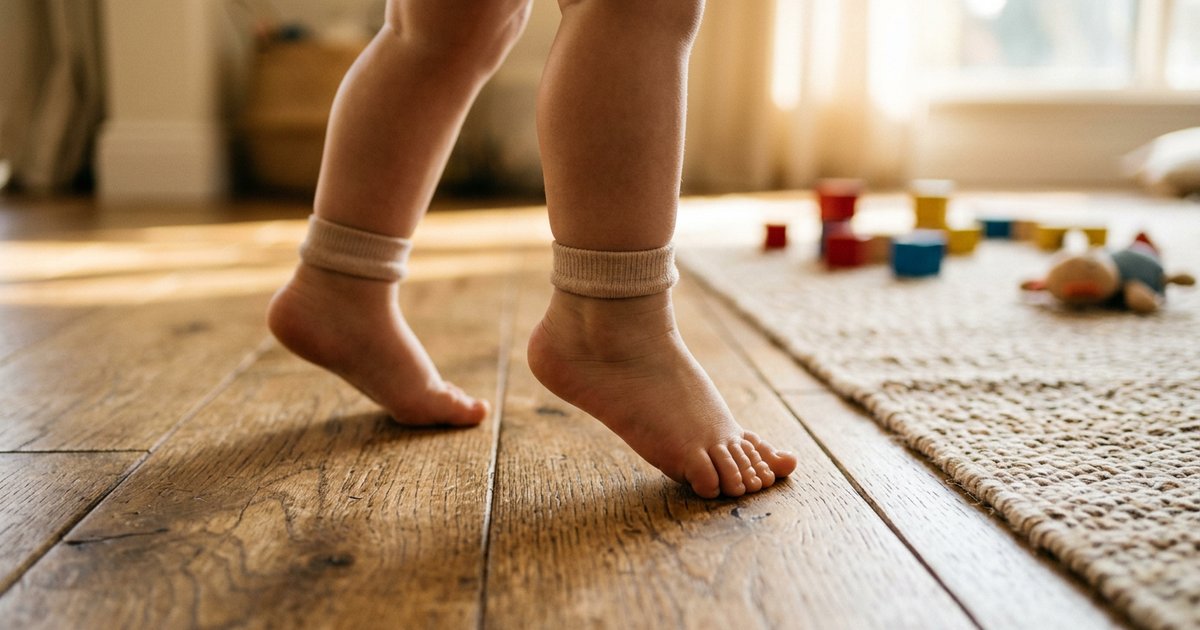
Toe walking means a child walks on the balls of their feet without the heel touching down. Most children walk heel-first (or flat-footed) once they've got the hang of walking.
Some toddlers toe walk when they're brand new walkers, or when they're excited, playing, or testing out how their feet work. That kind of on-and-off tiptoeing is very common and often fades by age 2 to 3.
When Toe Walking Is Usually Normal
It's usually not a concern when:
- Your child is a new walker (within the first few months of walking)
- They can easily walk flat-footed when you ask them or when they're reminded
- It only happens now and then, like when they're running or excited
- Their ankles and calves move freely and comfortably
- They're meeting other milestones, including speech, play, and motor skills
When to Get an Evaluation
It's a good idea to have your child looked at if:
- Toe walking is happening most of the time, or they can't stand flat-footed comfortably
- It's still going strong after age 2 to 3
- Their calves or ankles seem tight or stiff
- They trip or fall often, or seem clumsy compared to peers
- You've noticed delays in speech, motor skills, or social play
- Your child seems very sensitive to touch, textures, sounds, or movement
- One foot toe walks more than the other
Toe walking can sometimes be linked to tight calf muscles, balance and coordination differences, or sensory processing differences (some kids seek the feel of their toes pressing into the floor, or avoid the feel of the ground under their feet). Occasionally it's connected to a neurological or muscular condition, which is why a quick check by a professional is worth it, even if it turns out to be nothing.
Want a professional set of eyes on your child's walking? Learn more about our physical therapy services or reach out for a free consultation. We come to you.
What Happens at a Physical Therapy Evaluation?
A pediatric physical therapist (PT) looks at the whole picture, and the evaluation is play-based, so it doesn't feel like a test to your child. We typically look at:
- Range of motion: How far the ankles bend, and whether the calf muscles are tight
- Strength and balance: Core, hips, legs, and how steady your child is on their feet
- Walking and running patterns: How they move on different surfaces
- Sensory responses: Whether the ground, textures, or movement are bothering or attracting them
- Developmental history: Including speech, feeding, and play skills, because everything is connected
If we see something that would benefit from support, we'll build a plan with you. If we don't, you'll leave with peace of mind, and that matters too.
How Physical Therapy Helps
Treatment depends on why your child is toe walking, but it often includes:
- Gentle stretching and play-based calf and ankle work
- Strengthening the muscles that support a heel-down walk
- Balance and coordination games (think obstacle courses, animal walks, and jumping)
- Sensory strategies if the ground feels uncomfortable or your child craves pressure
- Simple home activities so progress continues between visits
- Coordination with your pediatrician if bracing or a specialist referral is needed
The best part? It looks like play. Kids don't know they're "doing therapy." They think they're being a bear, a crab, or a very fast dinosaur.
Why In-Home Therapy Works So Well for Toe Walking
Kids move differently in their own space. Seeing your child walk on your actual floors, around your actual furniture, helps us tailor activities that fit your daily routine. And you're right there, so you learn exactly what to do between sessions. No loading up the car, no waiting rooms, no naptime disasters.
Tips You Can Try at Home
While you're waiting for an evaluation, these gentle ideas can be fun for the whole family:
- Animal walks. Bear walks, crab walks, and frog jumps build heel-down strength and ankle flexibility.
- Barefoot play on different surfaces. Grass, sand, and carpet give helpful sensory input.
- Hill climbing. Walking up an incline naturally encourages the heel to come down.
- Heavy work. Pushing a laundry basket or pulling a wagon gives the body a lot of the input it may be craving.
- Avoid shaming or constant correcting. "Put your heels down!" can backfire. Keep it playful.
These aren't a replacement for an evaluation, but they're a kind starting point.
You're Doing a Great Job
If you've been worrying about your child's feet, the fact that you noticed and cared enough to look into it says a lot about you as a parent. Early support is powerful, and you don't have to figure it out alone.
Ready to Talk It Through?
If your toddler's toe walking has you wondering what to do next, we'd love to help. Book a free consultation with Eat. Play. Love. OT and we'll talk through what you're seeing, answer your questions, and let you know whether an evaluation makes sense. In-home and telehealth visits are available throughout San Diego County and Temecula.
We are in-network with United Healthcare, Optum, Tricare West, and Cigna/ASH.
We are a contracted provider with SDRC Early Start (vendor HQ2449) and Inland Regional Center (vendor PJ6193).
Based in Vista and serving Oceanside, Carlsbad, San Marcos, Encinitas, Temecula, and surrounding San Diego County, with in-home and telehealth visits available.