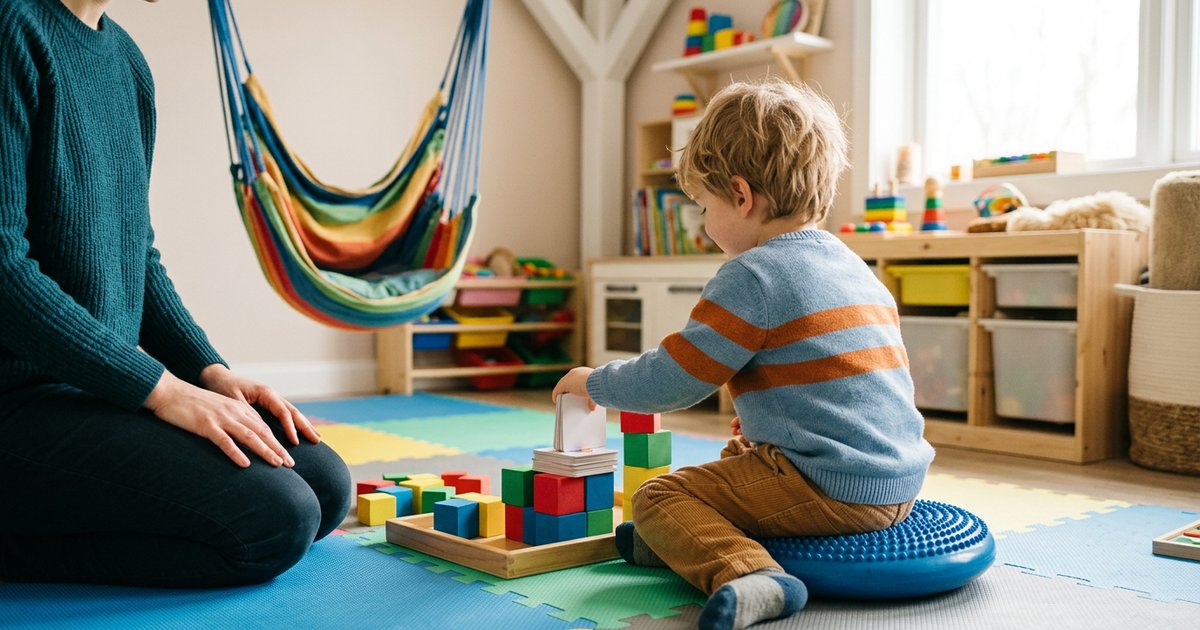
Your child is chatty at home. Silly, even — narrating their block towers, singing in the bath, telling you long looping stories about the dog. Then you walk into a birthday party, and they go quiet. Not shy-quiet. Gone-quiet. They cling to your leg, cover their ears, or bolt for the corner with the quietest toy.
Or maybe it's the opposite: your child is constantly moving, climbing, crashing, and words seem to be the last thing on their to-do list.
Parents often bring these two worries to us separately. I think we might need speech therapy. And also, He's so sensitive to noise — is that a separate thing?
Here's what a lot of families don't hear until they're already sitting in a therapy room: sensory processing and speech are deeply connected. Understanding that link often explains the puzzle pieces that never quite fit together.
What Is Sensory Processing, Exactly?
Sensory processing is how the brain takes in information from the world — sounds, sights, touch, smells, tastes, movement, and the body's own internal signals — and decides what to do with it.
Most of the time, this happens automatically. You filter out the hum of the refrigerator. You don't notice the tag in your shirt. Your body knows where it is in space without you thinking about it.
For some kids, that filtering system works differently. Sounds land louder. Touch feels sharper. Movement feels either irresistible or terrifying. Their nervous system is working overtime to sort through input that other people barely register.
That's not a character flaw or a discipline problem. It's a wiring difference — and it has real effects on everything else a child is trying to do, including talking.
Why a Regulated Body Comes Before Words
Here's the piece that reframes it for most parents: language is one of the last things the brain gets to.
When a child's nervous system feels overwhelmed — too loud, too bright, too itchy, too unpredictable — the brain prioritizes safety. It routes energy toward survival, not toward finding the right word, organizing a sentence, or coordinating the dozens of tiny muscle movements it takes to say it out loud.
Speech is a high-level skill built on a stable foundation. If the foundation is wobbling, the top floor gets shaky.
This is why a child can be verbal and expressive at home and nearly silent at a party. It isn't that the words disappeared. It's that the body decided it had bigger problems to solve first.
The Ways Sensory Differences Show Up in Speech
The connection plays out in a few common patterns:
Auditory processing and listening. A child who is overwhelmed by sound may struggle to pick out your voice from background noise. In a busy classroom, that means missing directions and missing the language models everyone else is soaking up.
Oral sensory input. The mouth is a sensory system too. Kids who are sensitive in and around the mouth may avoid certain textures, resist toothbrushing, or limit the range of mouth movements they're comfortable making — the same movements that build clear speech sounds. This is also why picky eating and speech concerns so often travel together.
Body awareness and motor planning. Speaking requires precise, coordinated movement of the lips, tongue, and jaw. Children who have trouble knowing where their body is in space often have trouble with that fine motor sequencing too.
Attention and availability. A child who needs constant movement to feel regulated may be too busy seeking input to sit and engage in back-and-forth conversation. The language isn't missing — the moment to use it is.
Social communication. When group settings feel like sensory chaos, kids withdraw. Fewer social opportunities means fewer chances to practice conversation, which slowly widens the gap.
Signs Worth Paying Attention To
None of these alone means anything is wrong. But if several feel familiar and show up week after week, they're worth mentioning to a professional:
- Talks freely at home but goes quiet in loud, busy, or new places
- Covers ears, or seems distressed by everyday sounds (blenders, hand dryers, gymnasiums)
- Has a very limited diet or strong reactions to food textures
- Avoids toothbrushing, face washing, or things near the mouth
- Seems to "not hear" you in noisy settings but hears fine in quiet ones
- Constantly moving, crashing, or seeking pressure — and language comes hard in those moments
- Has meltdowns after school or outings that look like a dam breaking
- Speech is unclear, and mouth movements seem effortful or imprecise
If you've been going back and forth wondering whether this is a speech thing or a sensory thing or a behavior thing — you're not being indecisive. You're noticing something real that genuinely does overlap. Plenty of thoughtful parents sit in exactly that spot before someone helps them connect the dots.
If it would help to talk it through with someone who looks at both sides, our pediatric therapy team is happy to listen.
What Helps at Home
You don't need equipment or a program to start supporting this today.
Regulate before you communicate. Before asking for words, help the body settle. A few minutes of movement, deep pressure, or a quiet corner does more for language than repeating a question three times.
Lower the sensory volume when it matters. For important conversations or new skills, choose the quiet room, turn off the TV, dim the chaos. You're clearing space for language to happen.
Build in heavy work. Carrying the grocery bag, pushing the laundry basket, animal walks down the hallway — this kind of input is organizing for most kids and often opens the door to more talking afterward.
Follow their lead in play. Kids talk most when they're comfortable and interested. Get on the floor, join what they're already doing, and narrate instead of quizzing.
Watch for the pre-meltdown window. Most kids give small signals before they tip. Responding early keeps them in the zone where learning and language are possible.
When to Reach Out for an Evaluation
Consider connecting with a therapist if your child's speech seems inconsistent depending on the setting, if sensory reactions are getting in the way of eating, sleeping, school, or family life, or if you've addressed one piece and the other keeps resurfacing.
Because this is an overlapping picture, it's often best looked at by a team. An occupational therapist can assess how your child's sensory system is working and what supports their regulation. A speech-language pathologist can look at how language and speech sounds are developing. When those two work together, families usually get answers faster — and a plan that actually fits the child in front of them.
You Don't Have to Figure Out Which One It Is
That's our job. You just have to tell us what you're seeing.
Whether your child is quiet in crowds, sensitive to sound, hesitant with food, or hard to understand, an evaluation is the simplest way to trade guessing for a clear path forward. And most parents leave feeling lighter — not because everything is fixed, but because it finally makes sense.
Curious whether sensory processing might be part of your child's speech picture? Book a free consultation with Eat. Play. Love. OT. We'll listen to what you're noticing, answer your questions, and help you find the right starting point — no pressure, just support.
We are in-network with United Healthcare, Optum, Tricare West, and Cigna/ASH.
We are a contracted provider with SDRC Early Start (vendor HQ2449) and Inland Regional Center (vendor PJ6193).
Based in Vista and serving Oceanside, Carlsbad, San Marcos, Encinitas, Temecula, and surrounding San Diego County, with in-home and telehealth visits available.