Does your child seem overwhelmed or overstimulated at meals? Calming strategies to try!

September 17, 2024

Calming Heavy Work Activities Before Meals: A Pediatric Occupational Therapist’s Guide

As a pediatric occupational therapist, I’ve witnessed how sensory strategies, particularly heavy work activities, can support children with sensory processing challenges. These activities, which involve pushing, pulling, lifting, or carrying, provide deep pressure input to the muscles and joints, which can be both calming and organizing for the nervous system.


In this blog, we’ll explore how calming heavy work activities can be used before mealtime to help children transition smoothly, reduce stress, and enhance focus during eating. If you’re a parent, teacher, or therapist working with children who have picky eating habits, sensory sensitivities, or struggles at the dinner table, these strategies could make mealtimes more enjoyable and successful.


What Are Heavy Work Activities and How Do They Help Before Meals?


Heavy work refers to activities that provide proprioceptive input, which is the body’s ability to sense its position and movement in space. This type of input is crucial for children who may feel overwhelmed by sensory stimuli such as lights, sounds, or textures.


When children engage in heavy work activities before meals, they benefit in several ways:

- Calming their nervous system: Heavy work helps soothe an overstimulated sensory system, making it easier to relax before eating.

- Increasing focus: By providing the body with deep pressure input, heavy work helps children concentrate on the task of eating.

- Reducing sensory overload: For children who are sensitive to food textures, smells, or sounds at mealtime, heavy work can provide a calming buffer.

- Improving transitions: Moving from playtime to sitting at the dinner table can be difficult, but incorporating proprioceptive activities can smooth this transition.


Benefits of Heavy Work for Picky Eaters and Sensory Seekers


Children with picky eating habits or sensory seeking or avoiding behaviors often struggle with mealtimes. They may become overstimulated or distracted, which can lead to mealtime battles or refusal to eat. Heavy work activities can be an essential part of a picky eater’s sensory diet, helping to calm their system and prepare them to engage more fully with the meal.


Top 10 Heavy Work Activities to Try Before Meals


These sensory-friendly activities are ideal for the 10-15 minutes before a meal and can easily be incorporated into your daily routine. The best part? They don’t require expensive equipment and can be done at home or in a classroom setting.


1. Carrying Groceries or Weighted Objects

Carrying weighted objects like grocery bags or laundry baskets provides proprioceptive input that helps ground a child’s sensory system.


2. Chair Push-Ups

A simple activity that can be done right at the dinner table. Have your child use their arms to push themselves up and down from their chair.


3. Animal Walks

Playful activities like bear crawls or crab walks provide deep pressure input and burn off extra energy before sitting down to eat.


4. Wall Push-Ups

Wall push-ups involve pushing the body against a wall, providing calming input to the muscles and joints.


5. Jumping on a Trampoline

For children with high energy, trampoline jumping for a few minutes helps them release energy in a controlled way before meals.


6. Weighted Vest or Lap Pad

For children who benefit from deep pressure, wearing a weighted vest or using a weighted lap pad during meals can help with focus and sensory regulation.


7. Pushing a Laundry Basket

Fill a laundry basket with blankets or pillows and have your child push it across the room for an effective heavy work activity.


8. Hanging from Monkey Bars or Swinging

For children who love climbing, hanging from monkey bars or a pull-up bar can provide intense proprioceptive input. Swinging in a blanket or a swing like this discounted one here can regulate and organize the sensory systems, too.


9. Resistance Band Exercises

Stretching and pulling with resistance bands engages the muscles and provides calming, organizing sensory input.


10. Stacking and Sorting Heavy Objects

Involve your child in simple chores like stacking cans or books to give them an opportunity to focus and engage their muscles before sitting down to eat.


Establishing a Routine with Heavy Work


Consistency is key when it comes to calming heavy work activities. Children thrive on routine, and establishing a pre-meal routine that includes heavy work can make a big difference in their mealtime behavior. Regular proprioceptive input can help children feel more organized and prepared for eating.


Here are a few tips for creating a successful pre-meal routine:

- Start with a favorite activity: Whether it’s pushing a laundry basket or jumping on a trampoline, choose an activity your child enjoys to make the transition smoother.

- Keep it consistent: Repeat the same heavy work activities before every meal to help your child’s body know what to expect.

- Pair with calming music or visuals: You can create a sensory-friendly environment by playing soft music or dimming the lights as part of your pre-meal routine.


---


How Heavy Work Supports Children with Sensory Processing Disorder (SPD)


Many children with sensory processing disorder (SPD) benefit from proprioceptive input as part of their daily routine. If your child has SPD, they may become easily overstimulated by the sights, sounds, and smells of mealtime. Heavy work activities help regulate their nervous system, making it easier for them to handle sensory input during meals.


Incorporating these activities into your child’s routine can also reduce stress and anxiety around eating. When the body is regulated and calm, children are more likely to engage in mealtime without feeling overwhelmed.


Heavy Work as Part of a Sensory Diet for Picky Eaters


If your child is a picky eater or has difficulties with the textures or smells of food, creating a sensory diet that includes heavy work activities before meals can be incredibly helpful. Sensory diets are individualized plans designed to provide the sensory input a child needs to stay regulated throughout the day.


Heavy work is often a key component of a sensory diet because it provides calming input that can reduce anxiety and improve focus. When a child feels more regulated, they are more likely to try new foods and engage with mealtime in a positive way.


How to Customize Heavy Work Activities for Your Child’s Needs


Every child is unique, and it’s important to tailor heavy work activities to your child’s individual sensory profile. Some children may prefer more intense activities like jumping or climbing, while others might find calm through quieter tasks like wall pushes or chair push-ups.


- Observe your child’s behavior: If your child becomes overstimulated after an activity, it might be too intense. In that case, try a gentler activity like using a weighted lap pad or pushing a laundry basket.

- Offer choices: Give your child options so they feel more in control. Let them choose between two or three heavy work activities before meals.

- Monitor progress: As you incorporate heavy work into your routine, observe how your child responds at mealtime. Are they more calm? Do they sit more easily? These are signs that the activity is working.


Conclusion: Setting the Stage for Calm, Focused Mealtime


Incorporating calming heavy work activities into your pre-meal routine is a simple yet effective way to help children regulate their sensory systems and prepare for eating. By providing deep proprioceptive input through pushing, pulling, lifting, or other weight-bearing activities, you can help your child transition smoothly into mealtime and enjoy a more focused, positive eating experience.


Whether your child struggles with sensory processing, picky eating, or mealtime meltdowns, these heavy work activities can make a significant difference in their behavior. By creating a consistent routine, you’re setting the stage for a calmer, more successful mealtime.


*If you have sensory or feeding concerns for your child, please discuss these with their pediatrician or speak to an OT.


By 649b196982c93800078add8f June 30, 2026
If your child isn't talking — or is talking very little — one of the most powerful tools available to them is something called AAC: Augmentative and Alternative Communication. And yet, it's one of the most misunderstood interventions in early childhood. Families worry that using AAC will make their child less likely to develop speech. They worry it's "giving up" on verbal communication. Neither is true. The research on this is clear and consistent: AAC supports speech development. It doesn't replace it. What Is AAC? AAC stands for Augmentative and Alternative Communication — any tool or strategy that supports or supplements spoken language. This includes: Low-tech AAC: Picture exchange systems (PECS) Communication boards Core word boards Printed symbol cards Mid-tech AAC: Single-message devices Step-by-step communicators Simple voice output devices High-tech AAC: Speech-generating devices (SGDs) — dedicated hardware or apps that allow a child to select symbols or text to produce speech Common apps include Proloquo2Go, TouchChat, LAMP Words for Life, and Snap Core First No-tech AAC: Sign language (particularly core vocabulary signs) Gestures Total Communication approaches Who Benefits from AAC? AAC is appropriate for any child who cannot currently communicate effectively through spoken language alone. This includes children with: Autism spectrum disorder (ASD) Childhood apraxia of speech (CAS) Global developmental delay Down syndrome Cerebral palsy Rare genetic syndromes Acquired neurological conditions AAC is also used during the evaluation and early treatment phase for any child whose communication is significantly delayed, to give them a functional way to communicate while speech develops. You do not need a specific diagnosis to benefit from AAC. If a child cannot effectively communicate their wants, needs, and thoughts through speech — AAC is worth exploring. Will AAC Stop My Child from Talking? This is the most common fear — and the research says the opposite is true. Study after study shows that AAC supports and accelerates speech development rather than inhibiting it. When children have a functional way to communicate: The pressure to produce speech is reduced, which often paradoxically helps speech emerge Children's vocabulary exposure increases as they use and hear language through the device Communication becomes rewarding and motivating — which drives more attempts to communicate Many children who begin with AAC develop increasing verbal speech alongside it over time AAC is not a last resort. For many children, it's a bridge to verbal communication. How AAC Therapy Works An SLP with AAC experience will: Evaluate your child's current communication — what they can do now, what modes they're using, and what they need Recommend appropriate AAC — not every child needs high-tech. The right AAC is the simplest system that gives them a functional voice Teach the child to use it — this takes time, modeling, and consistency Train the family and caregivers — AAC only works if the people around the child use it too Aided Language Stimulation (ALS) is a key strategy: adults model language by pointing to or activating the AAC system themselves as they speak, so the child sees the tool being used as a natural part of communication. Starting AAC Early The earlier a child has a functional way to communicate, the better. Waiting until a child is "old enough" or until speech "should have come by now" means months or years of frustration — a child who has things to say but no way to say them. Frustration, behavior challenges, and withdrawal are often symptoms of communication difficulty. Giving a child a voice — even a symbol board or a handful of signs — can transform behavior, reduce meltdowns, and strengthen connection with family. Next Steps If your child is minimally speaking or non-speaking, a speech-language pathology evaluation is the right first step. The SLP will assess their current communication, consider whether AAC is appropriate, and — if so — make a specific recommendation.  At Eat. Play. Love. OT, our SLPs specialize in working with non-speaking and minimally speaking children, including AAC assessment and implementation. We provide in-home and telehealth services throughout San Diego County. We are in-network with United Healthcare, Optum, Tricare West, and Cigna/ASH. Book a free consultation →
June 23, 2026
A pediatric occupational therapist's honest Prime Day 2026 picks — feeding, sensory and motor tools that actually get used at home. Sale runs June 23–26.
By 649b196982c93800078add8f June 23, 2026
My 2-Year-Old Isn't Talking — Should I Be Worried?
By 649b196982c93800078add8f June 15, 2026
5 Signs Your Child Might Need Speech Therapy
By 649b196982c93800078add8f June 15, 2026
Is My Child a Late Talker? What San Diego Parents Need to Know
By 649b196982c93800078add8f June 15, 2026
It's 5:47 PM and dinner is almost ready. You call your child to the table, and within 60 seconds — over what seems like absolutely nothing — everything falls apart. The crying. The floor. The complete and total chaos that leaves you standing at the stove wondering what just happened. You've tried everything. You've stayed calm. You've set limits. You've read the books. And yet, the meltdowns keep coming. Here's what I want you to hear before you read another word: you are not failing your child. And your child is not failing you. What's happening in those moments often has very little to do with behavior — and everything to do with the nervous system. Let me explain. What Is Sensory Processing, Exactly? Every single second of every day, your child's brain is receiving input from the world around them — sounds, lights, textures, smells, movement, temperature, the feeling of their clothes against their skin. For most people, the brain sorts through all of this automatically, in the background, without much effort. It decides what's important, what to ignore, and how to respond. But for some children, that sorting process doesn't work quite the same way. Their nervous systems are either over-responding (everything feels too loud, too bright, too much) or under-responding (they need more input than usual to feel regulated). Some kids do both, at different times, with different senses. This is called sensory processing differences — and it's far more common than most people realize. So What Does This Have to Do With Meltdowns? A meltdown — the real kind, not a "my kid is testing limits" tantrum — happens when a child's nervous system hits its maximum capacity. Think of it like a cup that keeps getting filled throughout the day. Every sensation that's hard to process adds a little more water. Every transition, every unexpected change, every itchy waistband, every flickering light. Little by little, all day long — until finally, something tiny tips the cup over. That "something tiny" is what you see as the trigger. But by the time the meltdown starts, the cup has been filling for hours. This is why the thing that "caused" the meltdown rarely makes sense from the outside. It wasn't about the fork. It was about everything that came before the fork. 5 Signs Your Child's Meltdowns Might Be Sensory You might be dealing with sensory-driven meltdowns if your child: 1. Reacts "way too big" to small things The tag in a shirt, the wrong color cup, a sound that no one else seems to notice — these aren't dramatic reactions to minor inconveniences. They're a nervous system that experiences those things as genuinely overwhelming. 2. Struggles with transitions more than other kids Moving from one activity to another — even fun things like leaving the park or stopping a movie — regularly results in major meltdowns. Their nervous system needs more time and preparation to shift gears. 3. Is extremely sensitive to clothing, food textures, or smells If getting dressed is a daily battle, if they'll only wear certain fabrics, if mealtimes are a constant struggle — sensory differences are often at the root. 4. Seeks intense physical input throughout the day Crashing into furniture, wanting to be squeezed tight, jumping off everything, hanging upside down — this isn't wild behavior. Their body is looking for the kind of deep pressure input that helps regulate their nervous system. 5. Has a hard time recovering once dysregulated A typical tantrum tends to fade once the limit is set or the child gets what they need. A sensory meltdown can last much longer — because the nervous system itself needs time to calm down, and no amount of logic or consequences will speed that up. What's Happening in the Brain During a Meltdown When your child's sensory system gets overwhelmed, their brain shifts into survival mode. The part of the brain responsible for logic, language, and learning essentially goes offline. They can't hear your reasoning. They can't "make better choices." They can't calm down on command — because the part of their brain that knows how to do that isn't running the show right now. This is why trying to have a conversation, explain consequences, or offer choices in the middle of a meltdown usually doesn't work. It's not defiance. It's neurology. The best thing you can do in that moment is focus on safety and connection — not problem-solving. What You Can Actually Do to Help Before the meltdown: This is where the real work happens. A regulated nervous system is less likely to hit overflow. Build in "sensory diet" activities throughout the day — things like jumping, heavy lifting, deep pressure, or calming sensory input (think: weighted blanket, slow swinging). These aren't extras. They're regulation tools. Watch for the warning signs that the cup is getting full — increased silliness, clinginess, sensitivity to things that normally don't bother them. These are your cues to slow down and add some regulating input before things escalate. Prep for transitions. Give advance warnings ("five more minutes, then we're leaving"). Use visual timers. Make the transition as predictable as possible. During a meltdown: Stay as calm as you can. Their nervous system will co-regulate with yours. Reduce sensory input — turn down lights, lower your voice, reduce stimulation. Stay nearby without demanding anything from them. Don't try to reason, problem-solve, or teach in this moment. That comes later. After a meltdown: Give them time to fully recover before reconnecting. Check in with warmth, not lectures. "That was really hard. I'm here." Once they're calm, you can briefly talk about what happened — but keep it short and simple. A Word to the Exhausted Parent If you're reading this after a really hard day, I just want to say: this is a lot to carry. Parenting a child with a sensitive nervous system is a different kind of hard. It requires a level of flexibility, patience, and attunement that doesn't always get recognized — even by the people closest to you. You are not spoiling your child by meeting them where they are. You are not making it worse by not being stricter. You are doing something really important and really hard, and you deserve support too. When to Reach Out for Help If meltdowns are happening daily, lasting a long time, causing injury, or significantly impacting your child's ability to participate in everyday life — it may be time to connect with a pediatric occupational therapist. An OT can evaluate your child's sensory processing, identify what's driving the dysregulation, and create a practical plan that actually fits your family. You don't have to figure this out alone. Have questions about your child's meltdowns or sensory behaviors? I'd love to hear from you — reach out here or book a free discovery call to learn more about how we can help.
December 2, 2025
The Best Pediatric Occupational Therapy Support for Temecula Families: Sensory, Feeding, and Early Intervention Help You Can Trust If you're a Temecula or Murrieta mom searching for support for your child’s sensory needs, feeding challenges, behavior, or developmental milestones—you’re in the right place. Eat. Play. Love. Occupational Therapy now proudly serves Temecula Valley , bringing neurodivergent-affirming, child-led, highly specialized OT straight to your home, school, or community setting. As a team of experienced pediatric occupational therapists, we help children build confidence, regulation, independence, and joy through developmentally appropriate, research-backed therapy that feels like play. Whether your child is a toddler exploring their world, a preschooler navigating new routines, or a school-aged kid needing support, Temecula families finally have access to quality, compassionate OT without long waitlists or overwhelm. Why Temecula Families Are Choosing Eat. Play. Love. OT Finding the right occupational therapist can feel overwhelming—especially when you're worried about sensory meltdowns, picky eating, school readiness, behavior struggles, or developmental delays. Temecula moms often tell us: “My child is constantly on the go.” “Transitions are so hard.” “Mealtimes are stressful.” “Their preschool teacher suggested an evaluation.” “I don’t know what’s normal anymore.” At Eat. Play. Love. OT, we take a warm, relational, whole-child approach that supports your child AND your family. More importantly: we meet your child where they are —with play, connection, and regulated nervous systems as our foundation. Pediatric Occupational Therapy Services We Offer in Temecula & Murrieta Our services are tailored to the unique needs of Temecula families: ⭐ Sensory Processing & Regulation Support We help children who are: Sensitive to noise, textures, clothing, or transitions Constantly moving or seeking big input Struggling with meltdowns or shutdowns Overwhelmed in busy environments Our sensory-informed strategies help your child feel safe, calm, and confident—whether at home, school, or in the community. ⭐ Feeding Therapy for Picky Eaters & Oral Development We specialize in gentle, child-led feeding support using: Dr. Yum and evidence-based feeding approaches AEIOU and SOS frameworks Responsive feeding Neurodivergent-affirming, pressure-free strategies Perfect for toddlers and children who: Eat fewer than 20 foods Gag or cry at mealtimes Prefer purees or specific textures Avoid family meals Have difficulty chewing Have allergies or oral-motor challenges Temecula moms love that we make feeding feel fun again. ⭐ Early Intervention (Ages 0–3) We work with SDRC-funded and private-pay families providing: Milestone development Play skills Sensory exploration Motor development Sleep routines Parent coaching Sessions happen in your home , where your child feels safe and learns best. ⭐ School-Aged Support (TK–5th Grade) For children navigating: Attention challenges Emotional regulation Executive functioning Fine-motor & handwriting Social skills School routine transitions We collabo rate with teachers, IEP teams, and parents to support your child across environments. Why In-Home OT Is a Game-Changer for Temecula Families Parents tell us again and again that in-home therapy is easier, more effecti ve, and less stressful. Benefits include: No traffic or rushing between activities Therapy happening in REAL environments Better generalization of skills Reduced overwhelm for sensory-sensitive children Personalized strategies for your home routines Ability for parents to o bserve and learn in real-time Our Temecula therapists bring sensory tools, motor activities, play-based setups, and feeding strategies directly to you. Meet Your Temecula OT Team Eat. Play. Love. OT is led by Lindsey Wood, MOT, OTR/L , pediatric occupational therapist and feeding specialist with over a decade of experience supporting neurodivergent children and coaching families. Our lead OT in the Temecula area, Cynthia, has years of experience treating littles with developmental delays and sensory differences. Our Temecula-based clinicians are: Highly trained Neurodiversity-affirming Relationship-first Play-centered Kind, warm, and deeply invested in your child’s success Families often say they feel relief after one session—because they finally feel seen, heard, and supported. Ready to Get Started? Here's How Eat Play Love OT Supports Temecula Families Getting started is simple: Step 1: Fill out our quick intake form We’ll learn about your child's needs and match you with the right clinician. Step 2: Schedule an evaluation We assess sensory, feeding, motor, and functional skills. Step 3: Receive a customized care plan You’ll get individualized strategies and a therapeutic plan tailored to your child. Step 4: Begin therapy sessions in-home We work collaboratively with you to support the whole child. Service Areas in Temecula Valley We currently serve: Temecula Murrieta Winchester French Valley Menifee Wildomar If you're unsure whether you’re in our service radius, reach out—we’re happy to check! Contact Eat. Play. Love. OT – Temecula 📞 Phone: 760-235-4748 📧 Email: intake@eatplayloveot.com 🌐 Website: www.eatplayloveot.com 📍 In-home services available We are a contracted vendor with Inland Regional Center . Request vendor PJ6193 with your service coordinator. Temecula families deserve accessible, compassionate, high-quality therapy without long waitlists. If you're a mom feeling overwhelmed, unsure, or ready for support, Eat. Play. Love. OT is here to walk alongside you. Your child deserves to feel regulated, confident, and understood—and we're here to help make that happen.
October 21, 2025
Discover 15 fun, sensory-friendly, non-candy treats for kids with autism. OT-approved ideas for parties, Halloween, classrooms, and therapy rewards!
October 7, 2025
Discover sensory-friendly Halloween ideas for kids in San Diego! From calm trick-or-treating and inclusive local events to OT-approved sensory play tips, Eat. Play. Love OT helps families enjoy a stress-free, fun Halloween.
August 27, 2025
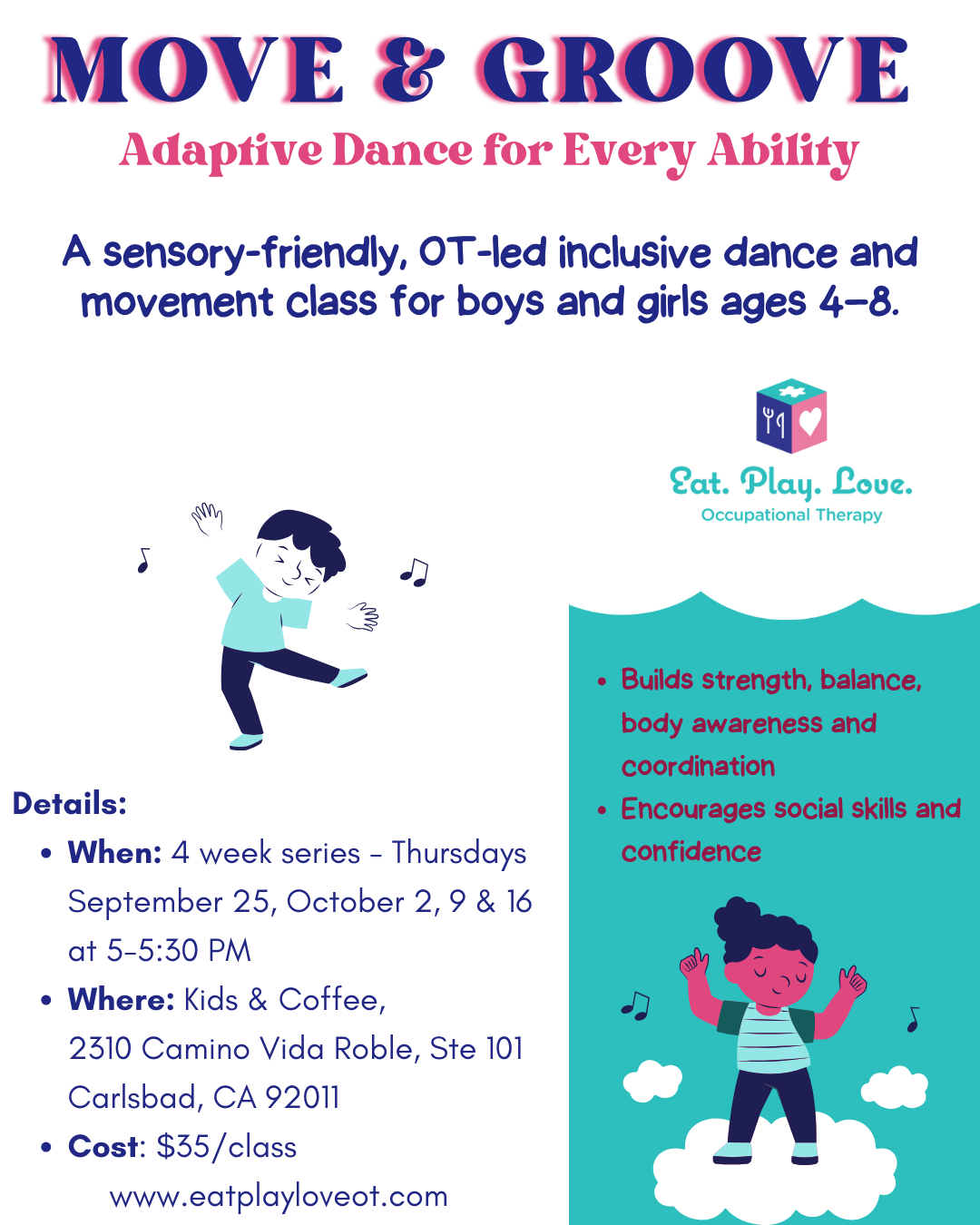
Move & Groove: Adaptive Dance Classes for Kids in San Diego Looking for fun, inclusive, and developmentally supportive kids’ classes in San Diego ? Eat. Play. Love. Occupational Therapy is proud to offer Move & Groove: Adaptive Dance for Every Ability , a sensory-friendly dance and movement program for children ages 4–8. This unique class is led by a pediatric occupational therapist trained in the DanceAbility® Method, ensuring every child can participate, grow, and shine. Why Adaptive Dance? Dance is a powerful tool for kids—it helps them build coordination, strength, and confidence. But not every child thrives in traditional dance settings. Loud music, fast-paced directions, and performance pressure can feel overwhelming, especially for children with sensory sensitivities or developmental differences. That’s where adaptive dance comes in. Our program focuses on inclusivity and celebrates every child’s unique way of moving. Instead of focusing on “perfect” steps, we emphasize creativity, connection, and joy. Benefits of OT-Led Dance Classes Because Move & Groove is led by an occupational therapist, the class supports both fun and function. Here’s what children gain: Strength & Coordination : Activities like jumping, balancing, and spinning build important motor skills. Sensory Regulation : Movement and music are structured to help kids stay calm, focused, and engaged. Social Confidence : Group activities encourage turn-taking, eye contact, and celebrating peers. Self-Expression : Children are free to move in their own way, reducing pressure and boosting self-esteem. What Makes the DanceAbility® Method Special? The DanceAbility® Method is internationally recognized for bringing people of all abilities together through improvisational dance. It focuses on connection, creativity, and inclusion. For children, this means a welcoming, pressure-free environment where they feel accepted and valued. Class Details – San Diego Adaptive Dance Program Ages: 4–8 Dates: Thursdays – September 25, October 2, 9, 16 Time: 5:00–5:30 PM Location: Kids & Coffee, 2310 Camino Vida Roble, Ste 101, Carlsbad, CA 92011 Cost: $35 per class Register: pci.jotform.com/form/251503802642146 Who Should Join? Move & Groove is perfect for: Kids with autism, ADHD, sensory processing challenges, or motor delays. Children who may not thrive in traditional dance classes. Any child who loves music, movement, and making friends! Why Parents Love It Families who join our kids’ classes in San Diego say their children leave happier, calmer, and more confident. Parents notice improvements in coordination, social skills, and self-esteem—and most importantly, they see their kids having fun. Sign Up Today If you’re searching for meaningful San Diego kids’ activities , Move & Groove is the perfect fit. Space is limited for this 4-week series, so don’t wait—reserve your child’s spot today! 👉 Register now here Move & Groove – Where ALL San Diego kids dance, connect, and grow!