The Importance of Messy Play in Feeding Development

April 12, 2024

Insight from a pediatric OT

As a pediatric occupational therapist (OT) specializing in feeding development, I have witnessed firsthand the profound impact that messy play can have on a child's ability to explore, engage, and succeed in feeding experiences. In this comprehensive blog post, I will delve into the significance of messy play in feeding development, exploring the underlying principles, benefits, and practical strategies for incorporating messy play into children's daily routines.


Understanding Messy Play: A Gateway to Sensory Exploration


Messy play involves hands-on activities that stimulate the senses and encourage children to explore different textures, temperatures, and consistencies. From finger painting with pudding to squishing playdough between their fingers, messy play provides valuable sensory experiences that lay the foundation for successful feeding development. Here's why messy play matters:


1. Sensory Integration: Messy play helps children integrate sensory information from their environment, improving their ability to tolerate and respond appropriately to different textures and sensations encountered during eating.


2. Motor Skill Development: Engaging in messy play supports the development of fine motor skills, such as grasping, pinching, and manipulating objects, which are essential for self-feeding and utensil use.


3. Desensitization: Exposure to diverse sensory experiences through messy play can desensitize children to aversive textures and tastes, reducing feeding aversions and selective eating behaviors.


4. Exploration and Curiosity: Messy play fosters a sense of curiosity and exploration around food, encouraging children to interact with new foods and expand their culinary repertoire.


The Intersection of Messy Play and Feeding Development


Feeding development encompasses a range of skills that contribute to successful eating and drinking experiences. Messy play serves as a powerful tool for enhancing these feeding-related skills:


1. Oral-Motor Skills:  Activities like blowing bubbles in yogurt or sucking pureed foods through a straw strengthen oral-motor muscles and improve coordination for chewing, swallowing, and speech production.


2. Sensory Processing:  Messy play exposes children to varied textures and tastes, supporting the development of sensory processing abilities crucial for accepting and enjoying a diverse range of foods.


3. Self-Regulation: Engaging in messy play helps children learn to regulate their responses to sensory stimuli, reducing mealtime anxiety and promoting a positive feeding environment.


4. Mealtime Participation: By participating in meal preparation activities involving messy play, children feel empowered and motivated to engage in family meals, fostering social interaction and mealtime enjoyment.


Practical Strategies for Incorporating Messy Play into Daily Routines


Here are some actionable tips and strategies for integrating messy play into children's daily routines to promote feeding development:


1. Texture Exploration: Offer a variety of textures for messy play, such as cooked pasta, mashed potatoes, and yogurt, allowing children to touch, squeeze, and explore with their hands.


2. Food Art and Play: Use food items like fruits, vegetables, and bread to create edible artwork, encouraging children to experiment with food presentation and creativity.


3. Sensory Bins: Create sensory bins filled with rice, beans, or lentils for tactile exploration, hiding small toys or utensils to enhance engagement and fine motor skills.


4. Cooking Together: Involve children in age-appropriate cooking tasks, such as mixing ingredients or kneading dough, to build confidence and familiarity with food preparation.


5. Outdoor Messy Play: Take messy play outdoors for added sensory stimulation, incorporating natural elements like sand, mud, and water into sensory activities.


Embracing Messy Play: Empowering Children and Families


In conclusion, messy play is a powerful tool for promoting feeding development and enhancing children's overall sensory and motor skills. As a pediatric OT, I encourage families and caregivers to embrace messy play as a fun and effective way to support children's exploration of food and feeding experiences.


If you have concerns about your child's feeding development or sensory processing abilities, consider consulting with a pediatric occupational therapist for personalized guidance and support. Together, we can empower children to develop positive relationships with food and thrive in their feeding journeys.


Thank you for joining me on this exploration of the importance of messy play in feeding development. Let's continue to celebrate the joy of messy exploration and nourish children's growth and development through playful learning experiences.


Stay messy, stay curious, and happy feeding! 🎨🍽️


June 23, 2026
A pediatric occupational therapist's honest Prime Day 2026 picks — feeding, sensory and motor tools that actually get used at home. Sale runs June 23–26.
By 649b196982c93800078add8f June 23, 2026
My 2-Year-Old Isn't Talking — Should I Be Worried?
By 649b196982c93800078add8f June 15, 2026
5 Signs Your Child Might Need Speech Therapy
By 649b196982c93800078add8f June 15, 2026
Is My Child a Late Talker? What San Diego Parents Need to Know
By 649b196982c93800078add8f June 15, 2026
It's 5:47 PM and dinner is almost ready. You call your child to the table, and within 60 seconds — over what seems like absolutely nothing — everything falls apart. The crying. The floor. The complete and total chaos that leaves you standing at the stove wondering what just happened. You've tried everything. You've stayed calm. You've set limits. You've read the books. And yet, the meltdowns keep coming. Here's what I want you to hear before you read another word: you are not failing your child. And your child is not failing you. What's happening in those moments often has very little to do with behavior — and everything to do with the nervous system. Let me explain. What Is Sensory Processing, Exactly? Every single second of every day, your child's brain is receiving input from the world around them — sounds, lights, textures, smells, movement, temperature, the feeling of their clothes against their skin. For most people, the brain sorts through all of this automatically, in the background, without much effort. It decides what's important, what to ignore, and how to respond. But for some children, that sorting process doesn't work quite the same way. Their nervous systems are either over-responding (everything feels too loud, too bright, too much) or under-responding (they need more input than usual to feel regulated). Some kids do both, at different times, with different senses. This is called sensory processing differences — and it's far more common than most people realize. So What Does This Have to Do With Meltdowns? A meltdown — the real kind, not a "my kid is testing limits" tantrum — happens when a child's nervous system hits its maximum capacity. Think of it like a cup that keeps getting filled throughout the day. Every sensation that's hard to process adds a little more water. Every transition, every unexpected change, every itchy waistband, every flickering light. Little by little, all day long — until finally, something tiny tips the cup over. That "something tiny" is what you see as the trigger. But by the time the meltdown starts, the cup has been filling for hours. This is why the thing that "caused" the meltdown rarely makes sense from the outside. It wasn't about the fork. It was about everything that came before the fork. 5 Signs Your Child's Meltdowns Might Be Sensory You might be dealing with sensory-driven meltdowns if your child: 1. Reacts "way too big" to small things The tag in a shirt, the wrong color cup, a sound that no one else seems to notice — these aren't dramatic reactions to minor inconveniences. They're a nervous system that experiences those things as genuinely overwhelming. 2. Struggles with transitions more than other kids Moving from one activity to another — even fun things like leaving the park or stopping a movie — regularly results in major meltdowns. Their nervous system needs more time and preparation to shift gears. 3. Is extremely sensitive to clothing, food textures, or smells If getting dressed is a daily battle, if they'll only wear certain fabrics, if mealtimes are a constant struggle — sensory differences are often at the root. 4. Seeks intense physical input throughout the day Crashing into furniture, wanting to be squeezed tight, jumping off everything, hanging upside down — this isn't wild behavior. Their body is looking for the kind of deep pressure input that helps regulate their nervous system. 5. Has a hard time recovering once dysregulated A typical tantrum tends to fade once the limit is set or the child gets what they need. A sensory meltdown can last much longer — because the nervous system itself needs time to calm down, and no amount of logic or consequences will speed that up. What's Happening in the Brain During a Meltdown When your child's sensory system gets overwhelmed, their brain shifts into survival mode. The part of the brain responsible for logic, language, and learning essentially goes offline. They can't hear your reasoning. They can't "make better choices." They can't calm down on command — because the part of their brain that knows how to do that isn't running the show right now. This is why trying to have a conversation, explain consequences, or offer choices in the middle of a meltdown usually doesn't work. It's not defiance. It's neurology. The best thing you can do in that moment is focus on safety and connection — not problem-solving. What You Can Actually Do to Help Before the meltdown: This is where the real work happens. A regulated nervous system is less likely to hit overflow. Build in "sensory diet" activities throughout the day — things like jumping, heavy lifting, deep pressure, or calming sensory input (think: weighted blanket, slow swinging). These aren't extras. They're regulation tools. Watch for the warning signs that the cup is getting full — increased silliness, clinginess, sensitivity to things that normally don't bother them. These are your cues to slow down and add some regulating input before things escalate. Prep for transitions. Give advance warnings ("five more minutes, then we're leaving"). Use visual timers. Make the transition as predictable as possible. During a meltdown: Stay as calm as you can. Their nervous system will co-regulate with yours. Reduce sensory input — turn down lights, lower your voice, reduce stimulation. Stay nearby without demanding anything from them. Don't try to reason, problem-solve, or teach in this moment. That comes later. After a meltdown: Give them time to fully recover before reconnecting. Check in with warmth, not lectures. "That was really hard. I'm here." Once they're calm, you can briefly talk about what happened — but keep it short and simple. A Word to the Exhausted Parent If you're reading this after a really hard day, I just want to say: this is a lot to carry. Parenting a child with a sensitive nervous system is a different kind of hard. It requires a level of flexibility, patience, and attunement that doesn't always get recognized — even by the people closest to you. You are not spoiling your child by meeting them where they are. You are not making it worse by not being stricter. You are doing something really important and really hard, and you deserve support too. When to Reach Out for Help If meltdowns are happening daily, lasting a long time, causing injury, or significantly impacting your child's ability to participate in everyday life — it may be time to connect with a pediatric occupational therapist. An OT can evaluate your child's sensory processing, identify what's driving the dysregulation, and create a practical plan that actually fits your family. You don't have to figure this out alone. Have questions about your child's meltdowns or sensory behaviors? I'd love to hear from you — reach out here or book a free discovery call to learn more about how we can help.
December 2, 2025
The Best Pediatric Occupational Therapy Support for Temecula Families: Sensory, Feeding, and Early Intervention Help You Can Trust If you're a Temecula or Murrieta mom searching for support for your child’s sensory needs, feeding challenges, behavior, or developmental milestones—you’re in the right place. Eat. Play. Love. Occupational Therapy now proudly serves Temecula Valley , bringing neurodivergent-affirming, child-led, highly specialized OT straight to your home, school, or community setting. As a team of experienced pediatric occupational therapists, we help children build confidence, regulation, independence, and joy through developmentally appropriate, research-backed therapy that feels like play. Whether your child is a toddler exploring their world, a preschooler navigating new routines, or a school-aged kid needing support, Temecula families finally have access to quality, compassionate OT without long waitlists or overwhelm. Why Temecula Families Are Choosing Eat. Play. Love. OT Finding the right occupational therapist can feel overwhelming—especially when you're worried about sensory meltdowns, picky eating, school readiness, behavior struggles, or developmental delays. Temecula moms often tell us: “My child is constantly on the go.” “Transitions are so hard.” “Mealtimes are stressful.” “Their preschool teacher suggested an evaluation.” “I don’t know what’s normal anymore.” At Eat. Play. Love. OT, we take a warm, relational, whole-child approach that supports your child AND your family. More importantly: we meet your child where they are —with play, connection, and regulated nervous systems as our foundation. Pediatric Occupational Therapy Services We Offer in Temecula & Murrieta Our services are tailored to the unique needs of Temecula families: ⭐ Sensory Processing & Regulation Support We help children who are: Sensitive to noise, textures, clothing, or transitions Constantly moving or seeking big input Struggling with meltdowns or shutdowns Overwhelmed in busy environments Our sensory-informed strategies help your child feel safe, calm, and confident—whether at home, school, or in the community. ⭐ Feeding Therapy for Picky Eaters & Oral Development We specialize in gentle, child-led feeding support using: Dr. Yum and evidence-based feeding approaches AEIOU and SOS frameworks Responsive feeding Neurodivergent-affirming, pressure-free strategies Perfect for toddlers and children who: Eat fewer than 20 foods Gag or cry at mealtimes Prefer purees or specific textures Avoid family meals Have difficulty chewing Have allergies or oral-motor challenges Temecula moms love that we make feeding feel fun again. ⭐ Early Intervention (Ages 0–3) We work with SDRC-funded and private-pay families providing: Milestone development Play skills Sensory exploration Motor development Sleep routines Parent coaching Sessions happen in your home , where your child feels safe and learns best. ⭐ School-Aged Support (TK–5th Grade) For children navigating: Attention challenges Emotional regulation Executive functioning Fine-motor & handwriting Social skills School routine transitions We collabo rate with teachers, IEP teams, and parents to support your child across environments. Why In-Home OT Is a Game-Changer for Temecula Families Parents tell us again and again that in-home therapy is easier, more effecti ve, and less stressful. Benefits include: No traffic or rushing between activities Therapy happening in REAL environments Better generalization of skills Reduced overwhelm for sensory-sensitive children Personalized strategies for your home routines Ability for parents to o bserve and learn in real-time Our Temecula therapists bring sensory tools, motor activities, play-based setups, and feeding strategies directly to you. Meet Your Temecula OT Team Eat. Play. Love. OT is led by Lindsey Wood, MOT, OTR/L , pediatric occupational therapist and feeding specialist with over a decade of experience supporting neurodivergent children and coaching families. Our lead OT in the Temecula area, Cynthia, has years of experience treating littles with developmental delays and sensory differences. Our Temecula-based clinicians are: Highly trained Neurodiversity-affirming Relationship-first Play-centered Kind, warm, and deeply invested in your child’s success Families often say they feel relief after one session—because they finally feel seen, heard, and supported. Ready to Get Started? Here's How Eat Play Love OT Supports Temecula Families Getting started is simple: Step 1: Fill out our quick intake form We’ll learn about your child's needs and match you with the right clinician. Step 2: Schedule an evaluation We assess sensory, feeding, motor, and functional skills. Step 3: Receive a customized care plan You’ll get individualized strategies and a therapeutic plan tailored to your child. Step 4: Begin therapy sessions in-home We work collaboratively with you to support the whole child. Service Areas in Temecula Valley We currently serve: Temecula Murrieta Winchester French Valley Menifee Wildomar If you're unsure whether you’re in our service radius, reach out—we’re happy to check! Contact Eat. Play. Love. OT – Temecula 📞 Phone: 760-235-4748 📧 Email: intake@eatplayloveot.com 🌐 Website: www.eatplayloveot.com 📍 In-home services available We are a contracted vendor with Inland Regional Center . Request vendor PJ6193 with your service coordinator. Temecula families deserve accessible, compassionate, high-quality therapy without long waitlists. If you're a mom feeling overwhelmed, unsure, or ready for support, Eat. Play. Love. OT is here to walk alongside you. Your child deserves to feel regulated, confident, and understood—and we're here to help make that happen.
October 21, 2025
Discover 15 fun, sensory-friendly, non-candy treats for kids with autism. OT-approved ideas for parties, Halloween, classrooms, and therapy rewards!
October 7, 2025
Discover sensory-friendly Halloween ideas for kids in San Diego! From calm trick-or-treating and inclusive local events to OT-approved sensory play tips, Eat. Play. Love OT helps families enjoy a stress-free, fun Halloween.
August 27, 2025
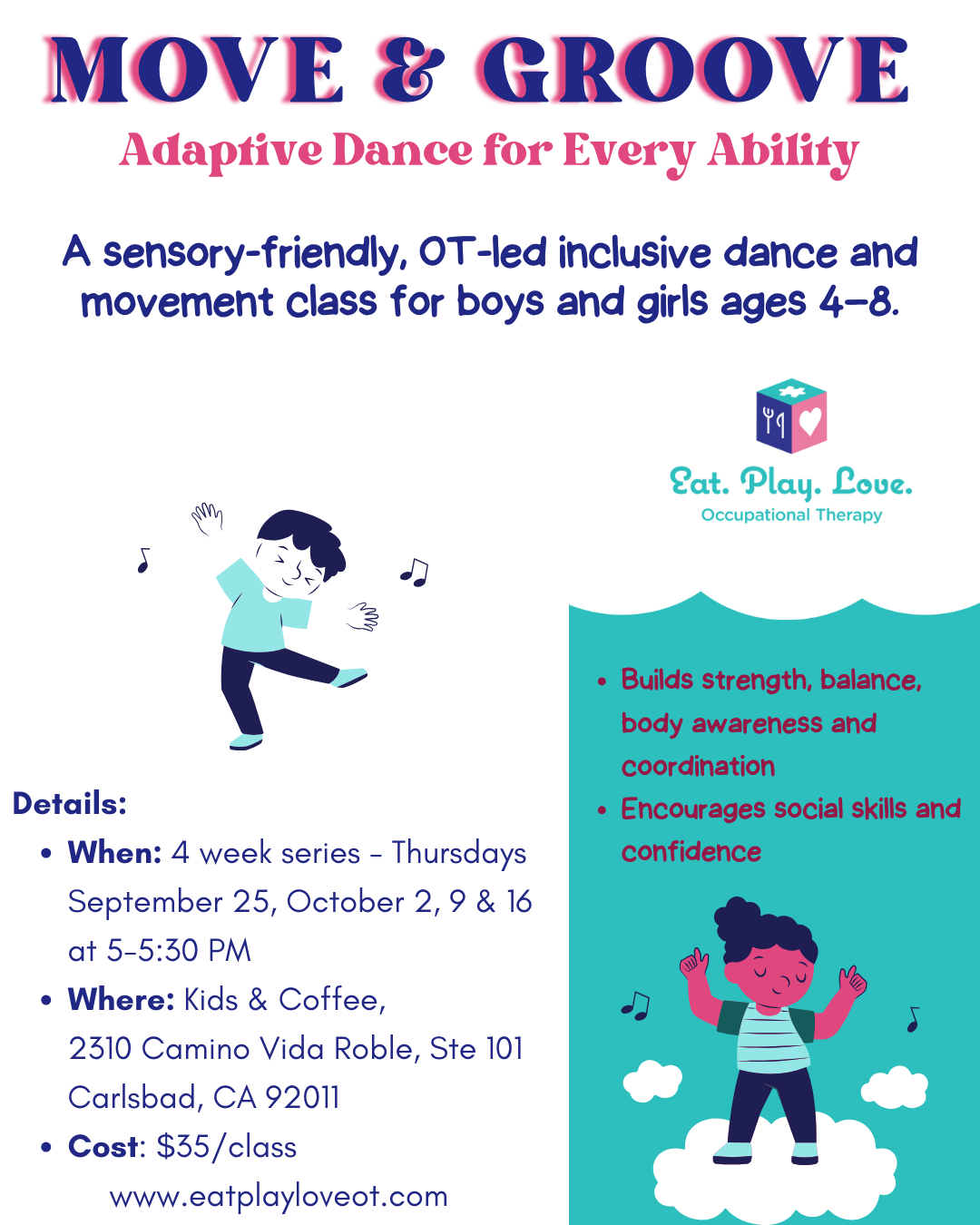
Move & Groove: Adaptive Dance Classes for Kids in San Diego Looking for fun, inclusive, and developmentally supportive kids’ classes in San Diego ? Eat. Play. Love. Occupational Therapy is proud to offer Move & Groove: Adaptive Dance for Every Ability , a sensory-friendly dance and movement program for children ages 4–8. This unique class is led by a pediatric occupational therapist trained in the DanceAbility® Method, ensuring every child can participate, grow, and shine. Why Adaptive Dance? Dance is a powerful tool for kids—it helps them build coordination, strength, and confidence. But not every child thrives in traditional dance settings. Loud music, fast-paced directions, and performance pressure can feel overwhelming, especially for children with sensory sensitivities or developmental differences. That’s where adaptive dance comes in. Our program focuses on inclusivity and celebrates every child’s unique way of moving. Instead of focusing on “perfect” steps, we emphasize creativity, connection, and joy. Benefits of OT-Led Dance Classes Because Move & Groove is led by an occupational therapist, the class supports both fun and function. Here’s what children gain: Strength & Coordination : Activities like jumping, balancing, and spinning build important motor skills. Sensory Regulation : Movement and music are structured to help kids stay calm, focused, and engaged. Social Confidence : Group activities encourage turn-taking, eye contact, and celebrating peers. Self-Expression : Children are free to move in their own way, reducing pressure and boosting self-esteem. What Makes the DanceAbility® Method Special? The DanceAbility® Method is internationally recognized for bringing people of all abilities together through improvisational dance. It focuses on connection, creativity, and inclusion. For children, this means a welcoming, pressure-free environment where they feel accepted and valued. Class Details – San Diego Adaptive Dance Program Ages: 4–8 Dates: Thursdays – September 25, October 2, 9, 16 Time: 5:00–5:30 PM Location: Kids & Coffee, 2310 Camino Vida Roble, Ste 101, Carlsbad, CA 92011 Cost: $35 per class Register: pci.jotform.com/form/251503802642146 Who Should Join? Move & Groove is perfect for: Kids with autism, ADHD, sensory processing challenges, or motor delays. Children who may not thrive in traditional dance classes. Any child who loves music, movement, and making friends! Why Parents Love It Families who join our kids’ classes in San Diego say their children leave happier, calmer, and more confident. Parents notice improvements in coordination, social skills, and self-esteem—and most importantly, they see their kids having fun. Sign Up Today If you’re searching for meaningful San Diego kids’ activities , Move & Groove is the perfect fit. Space is limited for this 4-week series, so don’t wait—reserve your child’s spot today! 👉 Register now here Move & Groove – Where ALL San Diego kids dance, connect, and grow!
July 21, 2025
Discover the Magic of Outdoor Learning: Nature Enrichment Pods in San Diego for Homeschoolers and Curious Kids